It's currently 1:11 AM, four hours and forty-nine minutes before I'm slated to leave for my first year of college at MIT. I've been wandering around my house for the past half-hour or so, gathering all the final electronics, toiletries, and other miscellania that eluded other attempts at packing from this past week. Amidst this, I think the fact has finally hit me: I'm about to leave what's been my home for the past eighteen years for something... well, mostly unknown.
There's all of the traditional uncertainties about leaving house and home and family that come with this, and fears of new situations to be sure, but right now I want to think about a different view of this critical point: the chance for self-improvement.
Sunday, August 18, 2013

Friday, August 2, 2013
Tube-Hack: Da Vinci Catapult
Every year, MIT traditionally sends acceptance letters in special silver-cardboard "tubes".
A cornerstone of MIT culture is the "hacking" ideology: taking everyday objects, places, and situations and creatively transforming them into something new, surprising, and often funny.
Bring these two together, and you have a tradition on its own: the first hacks by the freshman class are on the very tubes in which they learned of their admission.
A cornerstone of MIT culture is the "hacking" ideology: taking everyday objects, places, and situations and creatively transforming them into something new, surprising, and often funny.
Bring these two together, and you have a tradition on its own: the first hacks by the freshman class are on the very tubes in which they learned of their admission.
Wednesday, July 24, 2013
Can Video Games be Art?
Over the millenniums of human development, various inventions and technologies have been introduced which have enabled us vast new realms of artistic creation. The earliest of these was the spoken word, lending itself to traditional storytelling and histories. Soon after came visual arts and music, allowing humans to express themselves for the first time through external media. Then came possibly the greatest revolution: writing. Now, not only could we produce art, but leave a record of our stories far into the future.
In the past century alone, technology has accelerated and allowed so many huge revolutions in how we perceive art: the radio, movies, television - and yes, video games. The latter of these, however, has a certain stigma about it. Gaming is perceived as childlike, immature, a waste of time, useless. While this may be true of certain games, as it may be true for examples of any sort of media, I would argue that video games have just as much potential as any other form to make valuable, insightful, and significant contributions to society and culture.
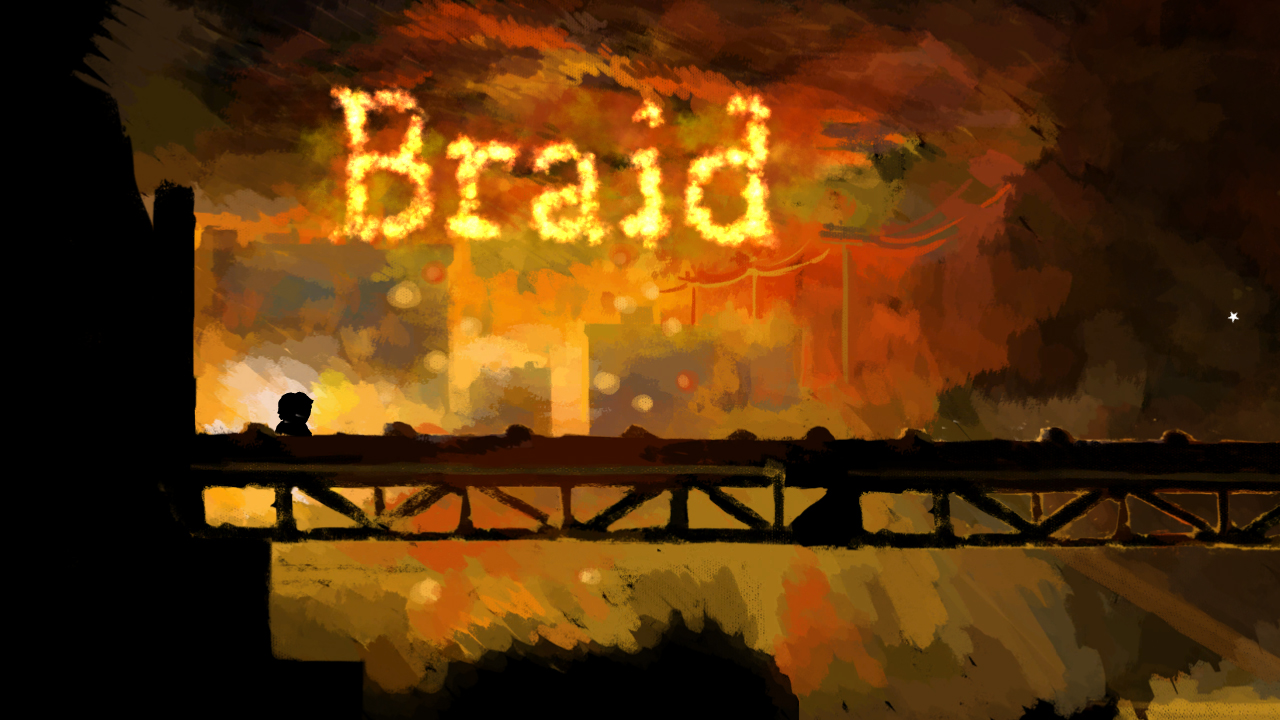

Take, for instance, the games pictured above: Braid is a game which pays homage to classics such as Mario, in which a hero attempts to save a princess. Through the course of the game, unique elements explore different aspects of time travel or manipulation through puzzle-solving, interspersed with world-building quotes and storytelling. At the end, however, it is revealed that instead of "saving" the princess, the protagonist was actually chasing her - revealing that obsessions can result in unexpected and negative effects on relationships.
Shadow of the Colossus, in somewhat of a parallel, explores a similar yet distinct theme: that an inability to let go and forget the past can transform the best-intentioned individuals into monsters. It does this as the protagonist ventures through the world, hunting down benign yet monstrous Colossi, in an attempt to save his perished love.
While there has been much creativity expressed in the short time gaming has existed, it continues to expand and grow as developers explore the limits of this art form - and I just find that absolutely exciting.
Tuesday, July 9, 2013
Digital Media, Sharing, and Music
Note: This was a message that I was sending to a few friends, if it seems more informal than normal. But I really felt good about what I said, so I wanted to share it here. I talked mainly about music, though I think it applies to literature as well to a lesser extent, and in some different directions with eBooks and the like.
A thought I had earlier today: digital music and media, particularly streaming services like Spotify and such, are really making me miss nostalgic for older days of mixtapes and CDs and physical things. Maybe it's unfounded, maybe it's just silly nostalgia because grass is greener and the past just seems better than the present, but there are pieces of things I think that have been lost somewhere along the line.
The specific thought that prompted this was the idea of sharing music. and I'm going to focus on music because I think that's the most extreme example of media affected by this, but other films and television and books are affected too. But I feel like it was once a bigger deal to go to a record store and DISCOVER new things, either alone or with others. and when you DISCOVERED these things, you placed value in them. Maybe you wouldn't like a particular CD or song, and if it was bad enough, you could sell it, but more likely than not it was yours. I've found most things like that that I listen to enough grow on me in time, though, and even become some of my favorites.
And that's the other thing. Nowadays, if you want to share music with people, there's word of mouth, or just playing it to them, or most common: sending a link to a song. It's easy. It's convenient. It should be excellent, yes? But no, I feel like with most way people share music now, it's more of a "lending" than a "gift", if that makes sense. You give people a link to a song, or play it for them once, and maybe they'll listen to it, but even if they do, there's just SO MUCH and it's SO EASY to listen to new (or more likely old comfortable) stuff people move on too soon. Sometimes, I really want to say "Here! Here are some really cool things! Treasure them, listen to them over and over and know them! Make this connection, share this passion for these songs with me!" But no, that's not something that happens anymore. It's weird even thinking about it.
And the reverse is true, back to DISCOVERY. I feel like I miss out on things other people are passionate about, because it seems people either don't share or they share constantly so that individual things have no meaning. It's impossible to filter.
Why do I care? I don't really know. I think I'm seeing music as a big part of my identity, or maybe it's that I want it to be more than it used to be. I'm certainly trying to make a conscious effort to explore more (like with the punk and post-punk stuff... I guess that was yesterday?) And that helps, but it also makes me realize and think about how things are different. That's kind of sad.
A thought I had earlier today: digital music and media, particularly streaming services like Spotify and such, are really making me miss nostalgic for older days of mixtapes and CDs and physical things. Maybe it's unfounded, maybe it's just silly nostalgia because grass is greener and the past just seems better than the present, but there are pieces of things I think that have been lost somewhere along the line.
The specific thought that prompted this was the idea of sharing music. and I'm going to focus on music because I think that's the most extreme example of media affected by this, but other films and television and books are affected too. But I feel like it was once a bigger deal to go to a record store and DISCOVER new things, either alone or with others. and when you DISCOVERED these things, you placed value in them. Maybe you wouldn't like a particular CD or song, and if it was bad enough, you could sell it, but more likely than not it was yours. I've found most things like that that I listen to enough grow on me in time, though, and even become some of my favorites.
And that's the other thing. Nowadays, if you want to share music with people, there's word of mouth, or just playing it to them, or most common: sending a link to a song. It's easy. It's convenient. It should be excellent, yes? But no, I feel like with most way people share music now, it's more of a "lending" than a "gift", if that makes sense. You give people a link to a song, or play it for them once, and maybe they'll listen to it, but even if they do, there's just SO MUCH and it's SO EASY to listen to new (or more likely old comfortable) stuff people move on too soon. Sometimes, I really want to say "Here! Here are some really cool things! Treasure them, listen to them over and over and know them! Make this connection, share this passion for these songs with me!" But no, that's not something that happens anymore. It's weird even thinking about it.
And the reverse is true, back to DISCOVERY. I feel like I miss out on things other people are passionate about, because it seems people either don't share or they share constantly so that individual things have no meaning. It's impossible to filter.
Why do I care? I don't really know. I think I'm seeing music as a big part of my identity, or maybe it's that I want it to be more than it used to be. I'm certainly trying to make a conscious effort to explore more (like with the punk and post-punk stuff... I guess that was yesterday?) And that helps, but it also makes me realize and think about how things are different. That's kind of sad.
Thursday, June 27, 2013
Sincerely, No-One
The personal letter has long since lost its reign in the realm of the mailbox. Ousted by the magazines I was gifted but don't really read, by the deluge of college postcards as they vie for attention, by those few bills my family hasn't switched to electronic payment, and by the ubiquitous, voluminous junk, there is simply no place for the personal letter in this high-technology world. It doesn't surprise me, then, to hear that the postal service has cut back on Saturday deliveries: this is simply not a medium that has a lot of use today.
But.
Is there value, is there meaning, is there importance to the personal, literary letter? I want to tackle this from a couple of angles: first, in comparison to the alternate forms of communication more readily available today. Personal, face-to-face is and (for the foreseeable future) will be relevant and independent of this discussion. Phone and video chat, struck a blow to letter-writing, but more addressed a long term extension of this direct discussion. No, the more tragic coup de grâce was the advent of email and text messaging. These forms of communication are fast, (mostly) reliable, and tie in neatly with the rest of the internet age. Seems perfect, right?
But.
Email, and texting, are by nature either too casual or too awkward to provide the same literary and practical benefits of letter writing. These technologies, while convenient, promote more casual writing styles. This isn't always a bad thing, but alongside the occasional ambiguity and discomfort in relation/length, these become more of a hindrance than an actual aide to communication.
Letter-writing, on the other hand, traditionally holds fast to well-written, grammatically correct content. From a standpoint of pure practice, it is beneficial - but its potential is so much more than that. Letters can be cathartic and therapeutic, allowing for the organization and verbalization of complex thoughts. They can develop deeper bonds between individuals, as the anticipation and receipt of letters drives people closer. They preserve the writing in a physical form for future generations.
So is there a point to the personal letter?
Yeah. I'd say so.
But.
Is there value, is there meaning, is there importance to the personal, literary letter? I want to tackle this from a couple of angles: first, in comparison to the alternate forms of communication more readily available today. Personal, face-to-face is and (for the foreseeable future) will be relevant and independent of this discussion. Phone and video chat, struck a blow to letter-writing, but more addressed a long term extension of this direct discussion. No, the more tragic coup de grâce was the advent of email and text messaging. These forms of communication are fast, (mostly) reliable, and tie in neatly with the rest of the internet age. Seems perfect, right?
But.
Email, and texting, are by nature either too casual or too awkward to provide the same literary and practical benefits of letter writing. These technologies, while convenient, promote more casual writing styles. This isn't always a bad thing, but alongside the occasional ambiguity and discomfort in relation/length, these become more of a hindrance than an actual aide to communication.
Letter-writing, on the other hand, traditionally holds fast to well-written, grammatically correct content. From a standpoint of pure practice, it is beneficial - but its potential is so much more than that. Letters can be cathartic and therapeutic, allowing for the organization and verbalization of complex thoughts. They can develop deeper bonds between individuals, as the anticipation and receipt of letters drives people closer. They preserve the writing in a physical form for future generations.
So is there a point to the personal letter?
Yeah. I'd say so.
Wednesday, June 12, 2013
On PRISM, Snowden, and other Recent Politics
In short: The NSA and the government are in the wrong, and this is very scary in its implications. Snowden, while maybe not the saint or hero that some make him out to be, made a hard decision for what he believed was the right thing based on the constitution and the will of the American people, and therefore should not face fear of prosecution or violence from his country.
Thursday, May 30, 2013
Looking back: what is a poem?
So, many weeks and a unit's worth of content later, we're just about done studying poetry. We've looking at its lingual tropes, figurative language, meanings, and analyses of content, structure, and more. Yet through all of this, we've yet to answer one of the first questions we asked ourselves: what is a poem?
Sunday, May 12, 2013
The Power of Birthdays

Malcolm Gladwell is sort of a hero of mine. The combination of entertainment, inquiry, and simple curiosity his works embody match very well with my own attitudes towards life; his clarity of writing and accessible style serve as a model for my own.
Thursday, May 2, 2013
Six things: a blogging retrospective
Nine months. Twenty-six blog posts. Six about books, three about music, two poems, and two more about poetry in general, with the rest distributed across a wider variety of topics.
I have to say, when I started this blog, I expected it to feel very much like "work": an assignment, a task, a thing I was forced to do because I would receive a grade for it. I would be lying if I said that was never the case, but more often than not (especially recently), it's become so much more than that. I've learned to express me, the myself of me clearly, and with that blogging has become as much a hobby as it is an assignment.
I have to say, when I started this blog, I expected it to feel very much like "work": an assignment, a task, a thing I was forced to do because I would receive a grade for it. I would be lying if I said that was never the case, but more often than not (especially recently), it's become so much more than that. I've learned to express me, the myself of me clearly, and with that blogging has become as much a hobby as it is an assignment.
Wednesday, April 24, 2013
Reflections on Dzhokhar
Hate begets hate. Fear begets fear. Anger begets anger, and war begets war. These are the things I have seen, and the things I believe.
As I said on Facebook, when I first heard about the bombings, the more productive response is to "listen and love to those who need it - this is how we survive, and how we carry on together". Unfortunately (but not surprisingly), this isn't what I've seen. Instead, there has been the senseless hate, the reactionary stereotyping and anger not only against those who committed these heinous crimes, but against fellow countrymen and the innocent who are only trying to express the complex emotions they experience in the ways they know.
Dzhokhar Tsarnaev and his late brother are (as all evidence indicates) criminals and terrorists, and thus the former absolutely deserves the consequences and punishments that the American justice system will bestow upon him. (The latter, of course, is beyond our mortal judgement now). However... as with everyone, they are human. They had families and friends, and grew up in normal schools. I say this not to evoke sympathy -- they made their choices consciously and intending of the pain they would cause -- but to propose the question of why? Why would people be driven to this? And what can we do to prevent this from happening again?
Hate begets hate, fear begets fear.
Amanda Palmer, about whom I have written in the past, authored a free-verse stream-of-conscious poem entitled "Poem for Dzhokhar", that she allegedly spent about 10 minutes writing in a moment of strong emotion. "art is how i deal," she says, and I identify strongly with that. In this poem, Amanda addresses herself, Dzhokhar, and the city of Boston, exploring their tumultuous thoughts throughout this chaotic week.
Predictably, it generated substantial controversy. People accused her of attention-mongering, of using the tragic events to further herself, of sympathizing with terrorists. They suggested she have her legs blown off, that she has no place to say anything for it was not her daughter or her friends who were killed. (It's worth noting that Amanda is a longtime resident of Boston). People hated her, people were angry, people insulted her -- but still others realized that she was really saying, humans are humans, we are all connected through these tragedies. I don't know how I feel about her poem itself, but I know this:
Hate begets hate.
And hate solves nothing.
As I said on Facebook, when I first heard about the bombings, the more productive response is to "listen and love to those who need it - this is how we survive, and how we carry on together". Unfortunately (but not surprisingly), this isn't what I've seen. Instead, there has been the senseless hate, the reactionary stereotyping and anger not only against those who committed these heinous crimes, but against fellow countrymen and the innocent who are only trying to express the complex emotions they experience in the ways they know.
Dzhokhar Tsarnaev and his late brother are (as all evidence indicates) criminals and terrorists, and thus the former absolutely deserves the consequences and punishments that the American justice system will bestow upon him. (The latter, of course, is beyond our mortal judgement now). However... as with everyone, they are human. They had families and friends, and grew up in normal schools. I say this not to evoke sympathy -- they made their choices consciously and intending of the pain they would cause -- but to propose the question of why? Why would people be driven to this? And what can we do to prevent this from happening again?
Hate begets hate, fear begets fear.
Amanda Palmer, about whom I have written in the past, authored a free-verse stream-of-conscious poem entitled "Poem for Dzhokhar", that she allegedly spent about 10 minutes writing in a moment of strong emotion. "art is how i deal," she says, and I identify strongly with that. In this poem, Amanda addresses herself, Dzhokhar, and the city of Boston, exploring their tumultuous thoughts throughout this chaotic week.
Predictably, it generated substantial controversy. People accused her of attention-mongering, of using the tragic events to further herself, of sympathizing with terrorists. They suggested she have her legs blown off, that she has no place to say anything for it was not her daughter or her friends who were killed. (It's worth noting that Amanda is a longtime resident of Boston). People hated her, people were angry, people insulted her -- but still others realized that she was really saying, humans are humans, we are all connected through these tragedies. I don't know how I feel about her poem itself, but I know this:
Hate begets hate.
And hate solves nothing.
Wednesday, April 10, 2013
Countdown
This was the poem I was putting together for the poet laureate competition. I was never happy enough with it to submit, but I figured I may as post it here, so the effort doesn't go completely to waste!
Thursday, March 28, 2013
zzzzzz
I stand before you, a man worn down by the tests of time, of fate, and of standing for 15 hours with nigh but a few isolated brakes in a convention center in Knoxville, Tennessee. You see, I am currently in the midst of an epic journey of engineering, driving, and crazy bus rides known as the First Robotics Competition (FRC)...
...or at least, that's what I was going to write about, until Aaron Karp stole my idea. So instead, lets talk about art theft (because really, what a thief. Like, for reals.)
A while back, a friend shared this article/book with me, discussing the role of "theft" in art, and what distinguishes good theft from bad. I find it an interesting concept - after all, in many ways, isn't all art derivative? Aren't all things simply the same stories, same tropes, and same characters repeated in distinct combinations? What then, distinguishes this "good theft" from the bad, the simple plagiarism or uncreative copying?

...or at least, that's what I was going to write about, until Aaron Karp stole my idea. So instead, lets talk about art theft (because really, what a thief. Like, for reals.)
A while back, a friend shared this article/book with me, discussing the role of "theft" in art, and what distinguishes good theft from bad. I find it an interesting concept - after all, in many ways, isn't all art derivative? Aren't all things simply the same stories, same tropes, and same characters repeated in distinct combinations? What then, distinguishes this "good theft" from the bad, the simple plagiarism or uncreative copying?
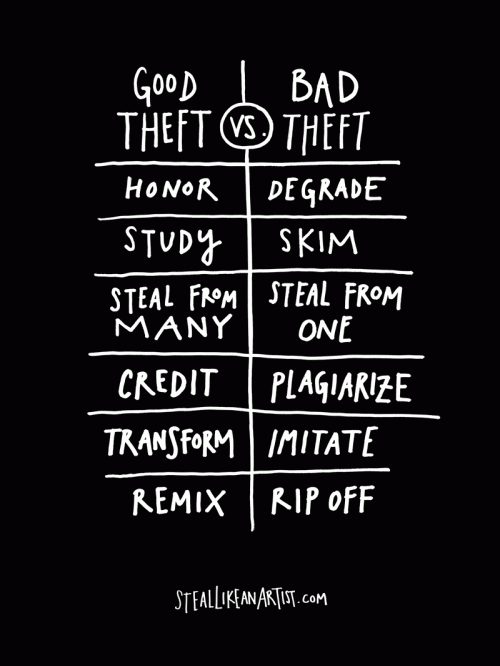
While you could examine each of these aspects in detail, the underlying concepts are of depth and spin - a necessary unique addition to any artistic theft that makes it new to the thief. Such is the passage of art and of story from generation to generation, words and pictures and sounds and stories through time, to be stolen from in turn at some later date.
It's a shame Aaron doesn't understand such depths, though.
Thursday, March 21, 2013
Album Analysis: Hospice by The Antlers
There is a close relationship between poetry and music - in particular, lyrical music. To be fair, they have their differences: lyrics tend to have more repetition, and poems are more wont to be less consistent in their meter and rhythm. Still, many of the same devices and features that are useful in analyzing poetry are similarly useful in examining songs.
With that in mind, I want to analyze a few songs from an album that I've recently found to be one of my favorite ever. This album is Hospice, by the Antlers.
With that in mind, I want to analyze a few songs from an album that I've recently found to be one of my favorite ever. This album is Hospice, by the Antlers.
Thursday, March 14, 2013
Thursday, February 28, 2013
beat
Poetry
is words
words with a flow, yes, words with
beat
rhyme
sing-song tag-along meter and 'mastery'
yet words, nonetheless
is words
words with a flow, yes, words with
beat
rhyme
sing-song tag-along meter and 'mastery'
yet words, nonetheless
Friday, February 22, 2013
Infinite Hipsterism
I'm about 35 pages into the 981 page behemoth which is David Foster Wallace's magnum opus, Infinite Jest. A brief overview, though clearly I'm not near far enough into the novel to know much for myself: Infinite Jest is (surprise surprise) a metafictional novel centered around an eponymous movie within the book. This movie is "so entertaining that anyone who watches it loses all desire to do anything but watch it", and so it quickly becomes the target of various groups and individuals who want to control it. While I haven't experienced enough to judge strongly either way, Wallace's writing and storybuilding are unique and fascinating, and I look forward to exploring them further over the coming days.
Thursday, February 7, 2013
Metablog (or Ramblings on Amanda Palmer)
I listen to a lot of music. My last blog touched on that subject, and I hope some of that passion I feel translated through that tenuous medium of text. I bring that up again to add emphasis and to show that it's not a simple empty statement when I say: Amanda Palmer is my favorite musician, likely ever. But this post isn't about music (though I would recommend you give hers a listen at some point in your life). This is a blog about blogging, because that's so delightfully meta, right?
Here's the deal: on top of being an excellent musician and songwriter, Amanda Palmer frequently blogs, on topics ranging from her music, to her life experiences, to musing on the internet and its nature. She's been doing so since 2003, so it's needless to say she has quite a bit of experience on the subject. That's why, especially considering this blog that I've been writing, I was particularly curious when she wrote this post titled "from under the hood of the blog".
Blogs are interesting. They're not professional, essay-style writing (though I suppose they can be, that's not how they are used best). From what I've seen, blogging as a medium is best when the emotions, thoughts, ideas and feelings are raw and untempered. Amanda says "my best blogs are the ones i write spontaneously when i wake up in the morning with a fresh head, or late at night with a melancholy window into the cosmos, and think “hey i’ll write a blog about what i’m thinking right now”.", and I believe it. The meticulously planned writing has its times and places, but I don't think that's what a blog is.
I've written two posts since I started this thing (maybe three now) that I've really felt like I been proud of. Funny enough, those first two came from conversations I had with friends: one on the lyrics of "Some Nights" by Fun., and my most recent post on digital media and music.
Looking at those, thinking now, what I really was proud of was my personality: I wasn't forcing myself to write that, I wasn't thinking about the grade I was receiving I was just writing to share my thoughts. So I'll make that a goal from now on, and maybe that means I won't be able to write about literature as much (sorry Mr. Mullins!) but I think it'll make my writing more interesting to read in the long run.
Here's the deal: on top of being an excellent musician and songwriter, Amanda Palmer frequently blogs, on topics ranging from her music, to her life experiences, to musing on the internet and its nature. She's been doing so since 2003, so it's needless to say she has quite a bit of experience on the subject. That's why, especially considering this blog that I've been writing, I was particularly curious when she wrote this post titled "from under the hood of the blog".
Blogs are interesting. They're not professional, essay-style writing (though I suppose they can be, that's not how they are used best). From what I've seen, blogging as a medium is best when the emotions, thoughts, ideas and feelings are raw and untempered. Amanda says "my best blogs are the ones i write spontaneously when i wake up in the morning with a fresh head, or late at night with a melancholy window into the cosmos, and think “hey i’ll write a blog about what i’m thinking right now”.", and I believe it. The meticulously planned writing has its times and places, but I don't think that's what a blog is.
I've written two posts since I started this thing (maybe three now) that I've really felt like I been proud of. Funny enough, those first two came from conversations I had with friends: one on the lyrics of "Some Nights" by Fun., and my most recent post on digital media and music.
Looking at those, thinking now, what I really was proud of was my personality: I wasn't forcing myself to write that, I wasn't thinking about the grade I was receiving I was just writing to share my thoughts. So I'll make that a goal from now on, and maybe that means I won't be able to write about literature as much (sorry Mr. Mullins!) but I think it'll make my writing more interesting to read in the long run.
Thursday, January 31, 2013
On The Road
(No, not that one.)
I first read The Road my sophomore year of high school, upon the insistence of a close friend when I told him I had owned it for a while but never actually read it. There was a period of time after this during which I might have called it my favorite book - it certainly ranked in my top few. I loved the atmosphere, I loved McCarthy's style, I loved the emotional impact from beginning to end. Over time, this was (as with most things) replaced by newer reads and stages of life, but The Road still help a special place for me, so I was understandably excited when I heard we would be reading it in AP Literature.
Still, I couldn't help be somewhat apprehensive... would it hold up to my memory? The answer is yes, and no, in some ways but not others. And while I could go point by point and give a simple review or analysis of the book, I don't think those are especially interesting, so I'll try something different, and look at my reaction and my memory and how they've changed my perception of the book over these years.
For one, I unfortunately have to say that while time may have softened my view of the novel, a second reading did little to push it back up in my mind. Is The Road an excellent book? Yes. Are there other books which I have found either more influential, significant, or enjoyable? Yes, without a doubt. The style, while once a novelty, is now simply distracting to read. The atmosphere, once fascinating, now feels rote and overused. That might be due to my own over-saturation in these more experimental or postmodern styles of novel or art, but the fact remains that many of the features I once found amazing are now simply tedious.
But enough on "good" or "bad", what's simply different? I've noticed much more philosophical musings this time around, I suspect I might have skimmed over those before out of a lack of understanding. Symbolism, motifs, and literary devices are much more at the forefront of my mind, likely due to the academic style analysis I've been preparing myself for. I've found myself paying more attention to the father and son and the relationships they have with each other and others rather than their environment as much.
What do these all say about me? I don't know. Maybe nothing at all, but nonetheless, it's interesting.
I first read The Road my sophomore year of high school, upon the insistence of a close friend when I told him I had owned it for a while but never actually read it. There was a period of time after this during which I might have called it my favorite book - it certainly ranked in my top few. I loved the atmosphere, I loved McCarthy's style, I loved the emotional impact from beginning to end. Over time, this was (as with most things) replaced by newer reads and stages of life, but The Road still help a special place for me, so I was understandably excited when I heard we would be reading it in AP Literature.
Still, I couldn't help be somewhat apprehensive... would it hold up to my memory? The answer is yes, and no, in some ways but not others. And while I could go point by point and give a simple review or analysis of the book, I don't think those are especially interesting, so I'll try something different, and look at my reaction and my memory and how they've changed my perception of the book over these years.
For one, I unfortunately have to say that while time may have softened my view of the novel, a second reading did little to push it back up in my mind. Is The Road an excellent book? Yes. Are there other books which I have found either more influential, significant, or enjoyable? Yes, without a doubt. The style, while once a novelty, is now simply distracting to read. The atmosphere, once fascinating, now feels rote and overused. That might be due to my own over-saturation in these more experimental or postmodern styles of novel or art, but the fact remains that many of the features I once found amazing are now simply tedious.
But enough on "good" or "bad", what's simply different? I've noticed much more philosophical musings this time around, I suspect I might have skimmed over those before out of a lack of understanding. Symbolism, motifs, and literary devices are much more at the forefront of my mind, likely due to the academic style analysis I've been preparing myself for. I've found myself paying more attention to the father and son and the relationships they have with each other and others rather than their environment as much.
What do these all say about me? I don't know. Maybe nothing at all, but nonetheless, it's interesting.
Friday, January 11, 2013
Ender's Game and Rereading Novels
There
are many reasons why we read, why we seek out stories and ideas in
written expression and take the time to experience them ourselves.
Sometimes, yes, it is pure entertainment. Sometimes, it is to
challenge our views, or to experience different forms of thought.
However, there are sometimes books that, for whatever reason, are so
inspiring, comforting, or influential that they attract us to read
them again and again until the story becomes as much our memory of it
as the words on the page.
For
me, sitting at home with an excess amount of free time over winter
break, I rediscovered the book that I feel has had the most influence
on me over the course of my life: Ender's
Game,
by Orson Scott Card. In tone and in story, Ender's
Game
can appear to be a book primarily appreciated by youth and teenagers.
As Card himself said, it is a story about children and their
experiences, so it makes sense that children would identify with it
and make connections with the characters. And to be true, when I
first read it years ago, I didn't make many deeper connections – it
was a story that I enjoyed for some indiscernible reason, and little
more than that.
As
I've grown older, I've come to appreciate more the power of the story
that Card told, and why it has had such an impact on me. Yes, Ender's
Game
is a story about children, but it does not glorify or trivialize
childhood or discount the humanity of children as many stories seem
to. It is, in fact, an utterly sad story when all is said and done: a
story of fear and war, and the lifelong pain they cause. It is this
collection of emotions that has held my fascination as I have
matured, and likely will continue to into my adulthood and beyond.
Subscribe to:
Comments (Atom)