It's currently 1:11 AM, four hours and forty-nine minutes before I'm slated to leave for my first year of college at MIT. I've been wandering around my house for the past half-hour or so, gathering all the final electronics, toiletries, and other miscellania that eluded other attempts at packing from this past week. Amidst this, I think the fact has finally hit me: I'm about to leave what's been my home for the past eighteen years for something... well, mostly unknown.
There's all of the traditional uncertainties about leaving house and home and family that come with this, and fears of new situations to be sure, but right now I want to think about a different view of this critical point: the chance for self-improvement.
Sunday, August 18, 2013

Friday, August 2, 2013
Tube-Hack: Da Vinci Catapult
Every year, MIT traditionally sends acceptance letters in special silver-cardboard "tubes".
A cornerstone of MIT culture is the "hacking" ideology: taking everyday objects, places, and situations and creatively transforming them into something new, surprising, and often funny.
Bring these two together, and you have a tradition on its own: the first hacks by the freshman class are on the very tubes in which they learned of their admission.
A cornerstone of MIT culture is the "hacking" ideology: taking everyday objects, places, and situations and creatively transforming them into something new, surprising, and often funny.
Bring these two together, and you have a tradition on its own: the first hacks by the freshman class are on the very tubes in which they learned of their admission.
Wednesday, July 24, 2013
Can Video Games be Art?
Over the millenniums of human development, various inventions and technologies have been introduced which have enabled us vast new realms of artistic creation. The earliest of these was the spoken word, lending itself to traditional storytelling and histories. Soon after came visual arts and music, allowing humans to express themselves for the first time through external media. Then came possibly the greatest revolution: writing. Now, not only could we produce art, but leave a record of our stories far into the future.
In the past century alone, technology has accelerated and allowed so many huge revolutions in how we perceive art: the radio, movies, television - and yes, video games. The latter of these, however, has a certain stigma about it. Gaming is perceived as childlike, immature, a waste of time, useless. While this may be true of certain games, as it may be true for examples of any sort of media, I would argue that video games have just as much potential as any other form to make valuable, insightful, and significant contributions to society and culture.
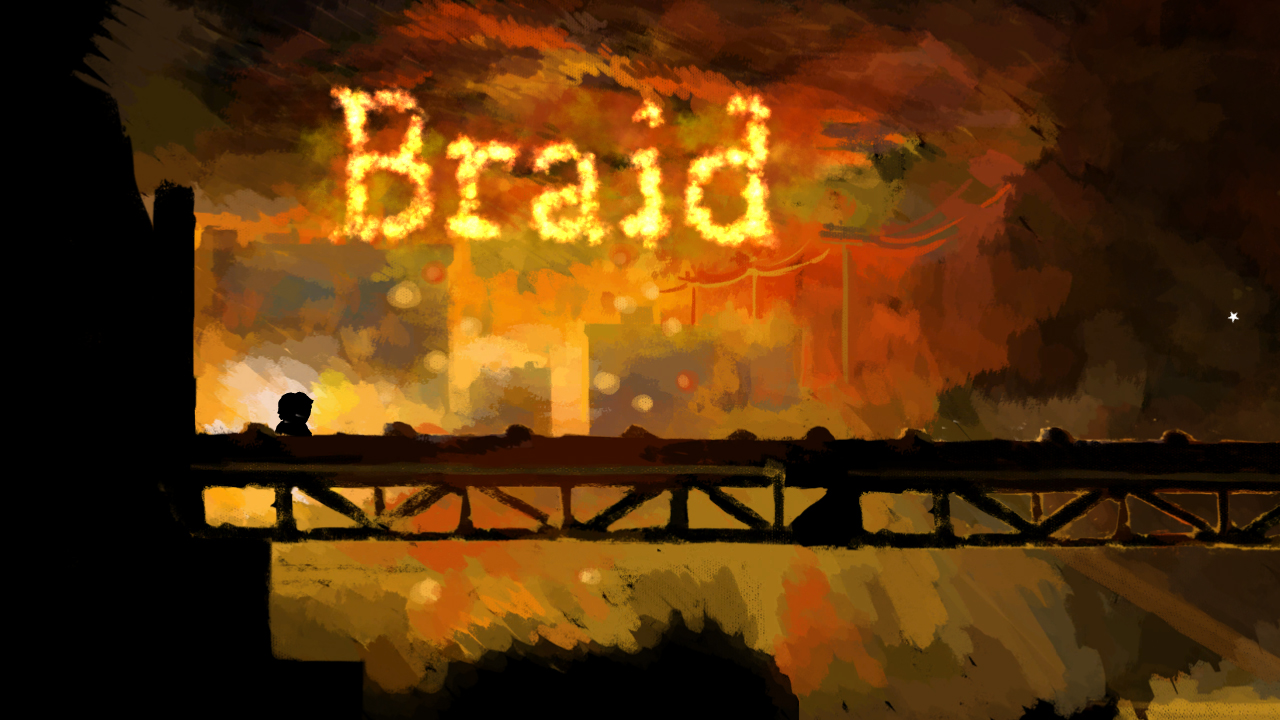

Take, for instance, the games pictured above: Braid is a game which pays homage to classics such as Mario, in which a hero attempts to save a princess. Through the course of the game, unique elements explore different aspects of time travel or manipulation through puzzle-solving, interspersed with world-building quotes and storytelling. At the end, however, it is revealed that instead of "saving" the princess, the protagonist was actually chasing her - revealing that obsessions can result in unexpected and negative effects on relationships.
Shadow of the Colossus, in somewhat of a parallel, explores a similar yet distinct theme: that an inability to let go and forget the past can transform the best-intentioned individuals into monsters. It does this as the protagonist ventures through the world, hunting down benign yet monstrous Colossi, in an attempt to save his perished love.
While there has been much creativity expressed in the short time gaming has existed, it continues to expand and grow as developers explore the limits of this art form - and I just find that absolutely exciting.
Tuesday, July 9, 2013
Digital Media, Sharing, and Music
Note: This was a message that I was sending to a few friends, if it seems more informal than normal. But I really felt good about what I said, so I wanted to share it here. I talked mainly about music, though I think it applies to literature as well to a lesser extent, and in some different directions with eBooks and the like.
A thought I had earlier today: digital music and media, particularly streaming services like Spotify and such, are really making me miss nostalgic for older days of mixtapes and CDs and physical things. Maybe it's unfounded, maybe it's just silly nostalgia because grass is greener and the past just seems better than the present, but there are pieces of things I think that have been lost somewhere along the line.
The specific thought that prompted this was the idea of sharing music. and I'm going to focus on music because I think that's the most extreme example of media affected by this, but other films and television and books are affected too. But I feel like it was once a bigger deal to go to a record store and DISCOVER new things, either alone or with others. and when you DISCOVERED these things, you placed value in them. Maybe you wouldn't like a particular CD or song, and if it was bad enough, you could sell it, but more likely than not it was yours. I've found most things like that that I listen to enough grow on me in time, though, and even become some of my favorites.
And that's the other thing. Nowadays, if you want to share music with people, there's word of mouth, or just playing it to them, or most common: sending a link to a song. It's easy. It's convenient. It should be excellent, yes? But no, I feel like with most way people share music now, it's more of a "lending" than a "gift", if that makes sense. You give people a link to a song, or play it for them once, and maybe they'll listen to it, but even if they do, there's just SO MUCH and it's SO EASY to listen to new (or more likely old comfortable) stuff people move on too soon. Sometimes, I really want to say "Here! Here are some really cool things! Treasure them, listen to them over and over and know them! Make this connection, share this passion for these songs with me!" But no, that's not something that happens anymore. It's weird even thinking about it.
And the reverse is true, back to DISCOVERY. I feel like I miss out on things other people are passionate about, because it seems people either don't share or they share constantly so that individual things have no meaning. It's impossible to filter.
Why do I care? I don't really know. I think I'm seeing music as a big part of my identity, or maybe it's that I want it to be more than it used to be. I'm certainly trying to make a conscious effort to explore more (like with the punk and post-punk stuff... I guess that was yesterday?) And that helps, but it also makes me realize and think about how things are different. That's kind of sad.
A thought I had earlier today: digital music and media, particularly streaming services like Spotify and such, are really making me miss nostalgic for older days of mixtapes and CDs and physical things. Maybe it's unfounded, maybe it's just silly nostalgia because grass is greener and the past just seems better than the present, but there are pieces of things I think that have been lost somewhere along the line.
The specific thought that prompted this was the idea of sharing music. and I'm going to focus on music because I think that's the most extreme example of media affected by this, but other films and television and books are affected too. But I feel like it was once a bigger deal to go to a record store and DISCOVER new things, either alone or with others. and when you DISCOVERED these things, you placed value in them. Maybe you wouldn't like a particular CD or song, and if it was bad enough, you could sell it, but more likely than not it was yours. I've found most things like that that I listen to enough grow on me in time, though, and even become some of my favorites.
And that's the other thing. Nowadays, if you want to share music with people, there's word of mouth, or just playing it to them, or most common: sending a link to a song. It's easy. It's convenient. It should be excellent, yes? But no, I feel like with most way people share music now, it's more of a "lending" than a "gift", if that makes sense. You give people a link to a song, or play it for them once, and maybe they'll listen to it, but even if they do, there's just SO MUCH and it's SO EASY to listen to new (or more likely old comfortable) stuff people move on too soon. Sometimes, I really want to say "Here! Here are some really cool things! Treasure them, listen to them over and over and know them! Make this connection, share this passion for these songs with me!" But no, that's not something that happens anymore. It's weird even thinking about it.
And the reverse is true, back to DISCOVERY. I feel like I miss out on things other people are passionate about, because it seems people either don't share or they share constantly so that individual things have no meaning. It's impossible to filter.
Why do I care? I don't really know. I think I'm seeing music as a big part of my identity, or maybe it's that I want it to be more than it used to be. I'm certainly trying to make a conscious effort to explore more (like with the punk and post-punk stuff... I guess that was yesterday?) And that helps, but it also makes me realize and think about how things are different. That's kind of sad.
Thursday, June 27, 2013
Sincerely, No-One
The personal letter has long since lost its reign in the realm of the mailbox. Ousted by the magazines I was gifted but don't really read, by the deluge of college postcards as they vie for attention, by those few bills my family hasn't switched to electronic payment, and by the ubiquitous, voluminous junk, there is simply no place for the personal letter in this high-technology world. It doesn't surprise me, then, to hear that the postal service has cut back on Saturday deliveries: this is simply not a medium that has a lot of use today.
But.
Is there value, is there meaning, is there importance to the personal, literary letter? I want to tackle this from a couple of angles: first, in comparison to the alternate forms of communication more readily available today. Personal, face-to-face is and (for the foreseeable future) will be relevant and independent of this discussion. Phone and video chat, struck a blow to letter-writing, but more addressed a long term extension of this direct discussion. No, the more tragic coup de grâce was the advent of email and text messaging. These forms of communication are fast, (mostly) reliable, and tie in neatly with the rest of the internet age. Seems perfect, right?
But.
Email, and texting, are by nature either too casual or too awkward to provide the same literary and practical benefits of letter writing. These technologies, while convenient, promote more casual writing styles. This isn't always a bad thing, but alongside the occasional ambiguity and discomfort in relation/length, these become more of a hindrance than an actual aide to communication.
Letter-writing, on the other hand, traditionally holds fast to well-written, grammatically correct content. From a standpoint of pure practice, it is beneficial - but its potential is so much more than that. Letters can be cathartic and therapeutic, allowing for the organization and verbalization of complex thoughts. They can develop deeper bonds between individuals, as the anticipation and receipt of letters drives people closer. They preserve the writing in a physical form for future generations.
So is there a point to the personal letter?
Yeah. I'd say so.
But.
Is there value, is there meaning, is there importance to the personal, literary letter? I want to tackle this from a couple of angles: first, in comparison to the alternate forms of communication more readily available today. Personal, face-to-face is and (for the foreseeable future) will be relevant and independent of this discussion. Phone and video chat, struck a blow to letter-writing, but more addressed a long term extension of this direct discussion. No, the more tragic coup de grâce was the advent of email and text messaging. These forms of communication are fast, (mostly) reliable, and tie in neatly with the rest of the internet age. Seems perfect, right?
But.
Email, and texting, are by nature either too casual or too awkward to provide the same literary and practical benefits of letter writing. These technologies, while convenient, promote more casual writing styles. This isn't always a bad thing, but alongside the occasional ambiguity and discomfort in relation/length, these become more of a hindrance than an actual aide to communication.
Letter-writing, on the other hand, traditionally holds fast to well-written, grammatically correct content. From a standpoint of pure practice, it is beneficial - but its potential is so much more than that. Letters can be cathartic and therapeutic, allowing for the organization and verbalization of complex thoughts. They can develop deeper bonds between individuals, as the anticipation and receipt of letters drives people closer. They preserve the writing in a physical form for future generations.
So is there a point to the personal letter?
Yeah. I'd say so.
Wednesday, June 12, 2013
On PRISM, Snowden, and other Recent Politics
In short: The NSA and the government are in the wrong, and this is very scary in its implications. Snowden, while maybe not the saint or hero that some make him out to be, made a hard decision for what he believed was the right thing based on the constitution and the will of the American people, and therefore should not face fear of prosecution or violence from his country.
Thursday, May 30, 2013
Looking back: what is a poem?
So, many weeks and a unit's worth of content later, we're just about done studying poetry. We've looking at its lingual tropes, figurative language, meanings, and analyses of content, structure, and more. Yet through all of this, we've yet to answer one of the first questions we asked ourselves: what is a poem?
Subscribe to:
Comments (Atom)